04/11/2026
CORROSION IN REINFORCED CONCRETE (RC)
CORROSION IN REINFORCED CONCRETE (RC)
The Hidden Threat to Structural Safety and Service Life
Concrete may appear strong and durable, but deterioration can develop beneath its surface long before visible damage occurs.
One of the most significant threats to reinforced concrete structures is steel reinforcement corrosion.
🔴 HOW DOES CORROSION OCCUR?
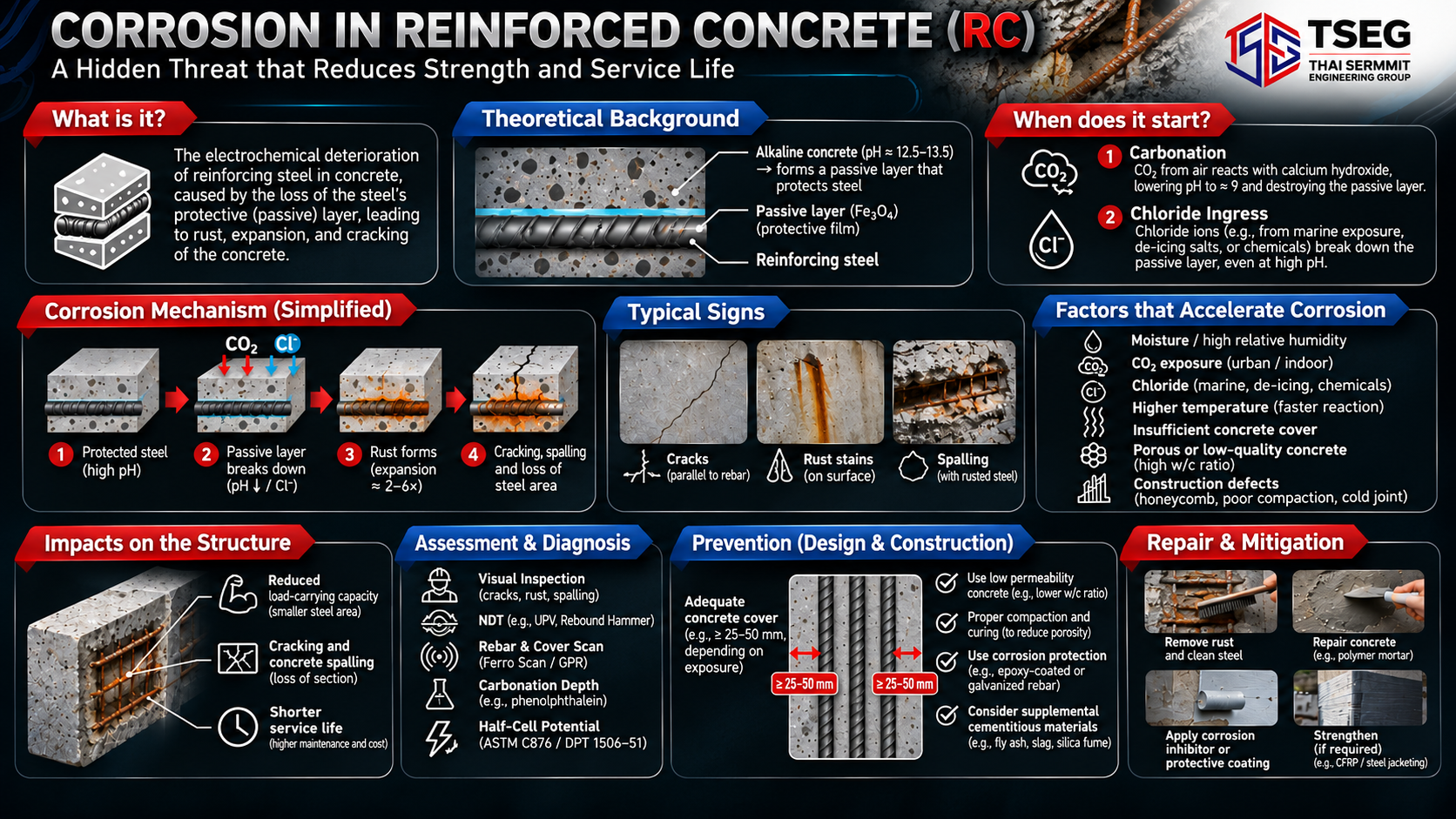
Under normal conditions, concrete's high alkalinity (typically pH 12.5–13.5) creates a protective passive layer around embedded steel reinforcement.
However, this protection can deteriorate through two primary mechanisms:
🔹 Carbonation: Atmospheric CO₂ penetrates the concrete and reacts with alkaline compounds, gradually reducing pH and potentially destroying the steel's passive layer.
🔹 Chloride Ingress: Chloride ions penetrate the concrete and can locally break down the passive layer, even when the surrounding concrete remains highly alkaline.
When the passive layer breaks down and sufficient moisture and oxygen are available, electrochemical corrosion can develop.
⚠️ FROM CORROSION TO STRUCTURAL DETERIORATION
The deterioration process generally follows four stages:
1️⃣ Passive Protection – Steel remains protected within alkaline concrete.
2️⃣ Depassivation – Carbonation or chloride exposure compromises the protective layer.
3️⃣ Corrosion Development – Rust products accumulate and generate expansive pressure within the concrete.
4️⃣ Structural Damage – Cracking, delamination, spalling, and reinforcement section loss may occur.
The consequences may include reduced steel cross-sectional area, weakened steel–concrete bond, reduced structural capacity, and shortened service life.
🔍 EARLY WARNING SIGNS
Watch for:
✔ Cracks following reinforcement lines
✔ Rust stains on concrete surfaces
✔ Delamination or concrete spalling
✔ Exposed or visibly corroded reinforcement
✔ Persistent moisture and water leakage
Important: Corrosion can develop before these symptoms become visible.
🛠️ HOW CAN WE ASSESS CORROSION?
A systematic engineering investigation may include:
🔹 Visual Inspection – Identify and map deterioration.
🔹 Half-Cell Potential (ASTM C876) – Evaluate the probability of active reinforcement corrosion.
🔹 Carbonation Depth Testing – Determine carbonation penetration relative to reinforcement cover.
🔹 Concrete Cover Measurement – Assess reinforcement location and protective cover thickness.
🔹 Chloride Content Testing – Evaluate chloride contamination at relevant depths.
🔹 UPV and Rebound Hammer Testing – Provide supplementary information on concrete condition and uniformity, but do not directly measure corrosion.
🛡️ PREVENTION IS BETTER THAN REPAIR
Long-term durability depends on proper structural design, adequate concrete cover, low-permeability concrete, effective curing, moisture control, and appropriate corrosion protection.
For existing structures, repair strategies should address both the **visible damage and its underlying cause to reduce the risk of recurring deterioration.
💡 ENGINEERING INSIGHT
Corrosion is not merely a surface defect. It is an electrochemical deterioration process that can progressively compromise structural performance.
Early detection, proper diagnosis, and timely intervention are essential to extending the service life of reinforced concrete structures.
━━━━━━━━━━━━━━━━━━
🏢 TSEG | Thai Sermmit Engineering Group
Structural Inspection • Material Testing • Structural Assessment • Strengthening & Rehabilitation
🌐 www.tseg.co.th
#TSEG #StructuralEngineering #ReinforcedConcrete #ConcreteCorrosion #StructuralInspection #ConcreteDeterioration #CorrosionAssessment #StructuralSafety #BuildingMaintenance #CivilEngineering